Skip to product information
1 of 2

〈 Tamato Town, Tamana District, Kumamoto Prefecture 〉 Junichi Nishida

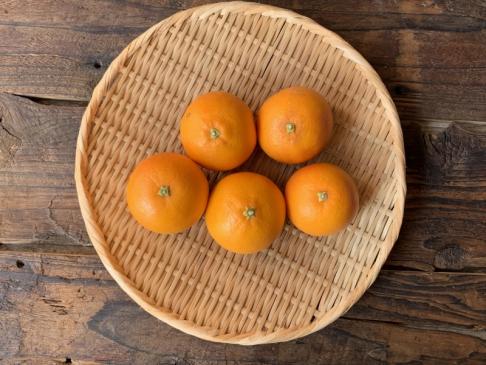
Naturally grown blood orange (Tarocco variety)

Naturally grown blood orange (Tarocco variety)

Regular price ¥780
Regular price Sale price ¥780
Sale Sold out
- Points
Tax included. Shipping calculated at checkout.
size

Naturally grown blood oranges from Nishida, Kumamoto Prefecture


[Blood oranges (Tarocco variety) from Junichi Nishida of Gyokuto Town, Kumamoto Prefecture]


We have received a shipment of blood oranges grown naturally without pesticides or fertilizers from Nishida in Gyokuto Town, Kumamoto Prefecture.


This is the first year that blood oranges have arrived, and although the yield was low, we at Purely are happy to stock them!


This time I was given two kinds: Moro and Tarocco.


The "Tarocco" variety has a fragrant, sweet taste, a strong sweetness, and a moderate acidity, and is full of juice. The flesh is soft and the membrane is thin, so it's easy to eat.


Naturally grown Beni Hachisaku oranges from Nishida, Kumamoto Prefecture Nishida has been engaged in natural fruit cultivation in Gyokuto Town, Kumamoto Prefecture since 2007.
For many years, they have been engaged in the natural cultivation of fruit trees such as peaches, honey rosa (plums), Taishu persimmons, gold kiwis, and Hassaku oranges, which were previously said to be "impossible" to grow without the use of pesticides.
Nishida's "Nishida Orchard" is located in Gyokuto Town, Tamana County, Kumamoto Prefecture, which is famous as the "village of mandarin oranges and historical sites."
Nishida returned to his hometown of Kumamoto in 2000 and began working in his family's orchard as the successor.
We started without knowing anything about natural farming. We sprayed chemical fertilizers and pesticides every day as if that were the normal thing to do.
However, as I continued, I began to have doubts about the large amounts of pesticides being used.


"Pesticides are sprayed dozens of times. I wouldn't want to eat fruit that has been soaked in those pesticides."


Nishida's feelings gradually grew stronger.
While keeping an eye on environmentally conscious agriculture, a series of connections led to our encounter with Purely.
"At first I was surprised, thinking, 'Natural farming without the use of pesticides or fertilizers. There's a farming method like this!' But then I began to feel strongly that, since I'd come back to my hometown of Kumamoto, I wanted to practice natural farming that is kind to both the environment and people."


After meeting Purely, Nishida began practicing natural farming in small areas in 2007.


Taking on the challenge of natural cultivation without fertilizers or pesticides
As is generally true for all citrus fruits, the trees themselves are not very strong and are said to be susceptible to damage from diseases and pests.
For this reason, more pesticides and fertilizers are used on these crops than on other fruit trees.
Instead, it is the naturally occurring insects that play an active role at Nishida Orchard.


"Because I don't use pesticides, my orchard is home to a diverse range of living things.
For example, the newly hatched spiderlings will prey on mites and other insects that harm peaches."


In conventional farming, insects are considered pests and are thoroughly eradicated using pesticides.

"The insects are employees of Nishida Orchard."


He describes his orchard as being in harmony with nature.


Moonlight Cultivation
Nishida places great importance on diversity in his work, and at the same time practices "moon reading cultivation" that incorporates the phases of the moon into cultivation. Living things on Earth are affected by the gravitational force of the moon and the gravity of the earth in terms of growth and birth, and he works in accordance with these forces.
Nishida schedules his farm work by looking at the lunar calendar.
For example, mowing the grass at this time, when the Earth's gravity is strongest as we approach the new moon, is said to have the effect of suppressing the upward tendency of weeds after mowing.
In addition, around the time of the full moon, when the gravitational force of the moon is strongest, the fruit absorbs moisture and minerals, ripening the fruit so that animals can eat it and carry the seeds. Nishida tries his best to harvest the fruit at the time when it is most suitable for people to eat it.
I got the impression from Nishida that he sees even the energy from space as part of nature, and that he listens to the feelings of the crops.

Varieties

Producer

Junichi Nishida

Producing area

Tamato Town, Tamana District, Kumamoto Prefecture

Farming method

Natural cultivation

Species Information

Fruit trees

Size and Capacity

500g~

View full details